
Dr. Hermann Eiselen l Foundation fiat panis

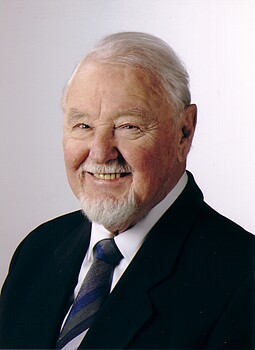
Dr. Hermann Eiselen (1926–2009)

Entrepreneur, philanthropist, and pioneer of private research funding in the fight against hunger and poverty

Hermann Eiselen was born in 1926 in Nagold and studied economics in Stuttgart and Heidelberg. After earning his doctorate in Göttingen in 1951, he joined the family company Ulmer Spatz Vater und Sohn Eiselen as managing partner in 1954.

Together with his father, he founded the German Bread Museum in Ulm in 1955, known today as the Museum of Bread and Art. This was followed in 1978 by the founding of the nonprofit Vater und Sohn Eiselen Foundation. In 2000, Hermann Eiselen went on to establish the fiat panis Foundation, intended to carry forward his commitment to research funding in the field of global food security over the long term.

Throughout his life, Hermann Eiselen engaged intensively with questions of global food security, nutrition, and poverty reduction. In numerous publications and lectures, he emphasized in particular the importance of agricultural research for a world without hunger. In recognition of his commitment, he received, among other honors, the Bundesverdienstkreuz 1. Klasse (Officer's Cross of the Order of Merit of the Federal Republic of Germany) and an honorary doctorate from the University of Hohenheim.

Hermann Eiselen died in 2009 at the age of 83.

Research for a World Free of Hunger

The fiat panis Foundation — Latin for "let there be bread" — continues Hermann Eiselen's commitment to research funding aimed at improving global food security. Its focus is on supporting science and early-career researchers, particularly on questions of food security and the fight against hunger and rural poverty.

The Foundation maintains a long-standing partnership with the University of Hohenheim. Among other initiatives, its Dr. Hermann Eiselen Scholarship Program supports students conducting research abroad for their master's theses in countries of the Global South, and it funds additional activities in the field of food security.

Another focus is recognizing outstanding scientific achievement. To this end, the Foundation awards three science prizes covering different career stages — from master's theses to dissertations to outstanding lifetime scientific achievement.

Awards

Justus von Liebig Prize for World Food Security

The Justus von Liebig Prize for World Food Security honors individuals or institutions who have contributed to improving global food security through outstanding scientific achievements, significant innovations, or an exceptional body of work.

Unlike the two early-career awards, the focus here is not on a single thesis, but on a comprehensive scientific or practical contribution to the fight against hunger and rural poverty.

Prize money: €25,000
Frequency: every two years
Focus: Outstanding achievements and lifetime contributions to global food security
2025 Laureate: Dr. Sunday Ekesi

The internationally renowned entomologist was honored for his scientific achievements and their practical significance for sustainable agriculture and food security in Africa. The award ceremony took place as part of Tropentag 2025 at the University of Bonn.

Hermann Eiselen Science Award

The Hermann Eiselen Science Award honors outstanding dissertations that make an innovative scientific contribution to improving the food situation in developing countries. The award is presented every two years and is aimed at especially qualified early-career researchers.

The award has existed since 1986 and has carried Hermann Eiselen's name since 2021.

Prize money: €30,000
Frequency: every two years
Focus: Outstanding dissertations on food security
The Hermann Eiselen Science Award 2026 will be presented in September 2026 at the University of Göttingen.

Hans H. Ruthenberg Graduate Award

The Hans H. Ruthenberg Graduate Award has recognized outstanding diploma and master's theses since 1999 that contribute to improving the food situation in developing countries. The award is aimed in particular at early-career researchers at the beginning of their academic careers.

Prize money: €2,500 per awarded thesis
Awarded since: 1999
Focus: Outstanding diploma and master's theses
2025 Laureates:
Chiara Masser, Simone Martina Dani Melder, and Gabriel Alejandro Villanueva Zapata